To confirm you are dealing with the factory, cross-check three pieces of evidence: a business license with manufacturing in its scope, a product certificate that names that company as the production site, and a video call on the line where your model is assembled and tested. If all three match on name and address, you are very likely talking to the factory.
A fan factory and an office that resells fans can share the same catalog, the same photos and the same price on the first quote. The difference shows when something goes wrong and has to be fixed on the line.
In electronics and appliances, hardly any plant makes everything in-house. A TV factory may buy the main board from another company and assemble the rest. What you need to know is who assembles, who tests and who answers for the finished product.
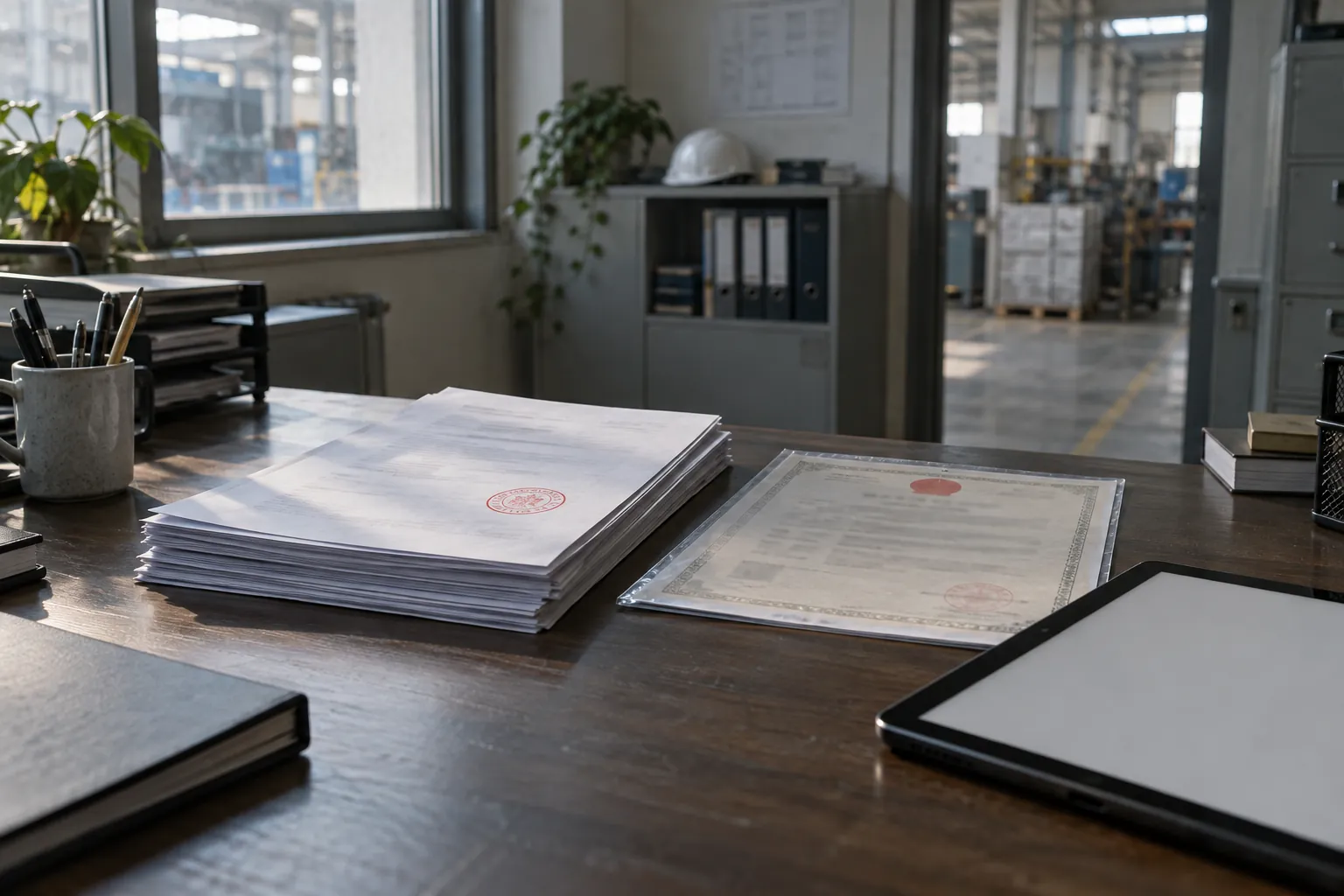
The license shows what the company may do
Every Chinese company has a business license with an 18-character unified social credit code. With that code you can look it up in the National Enterprise Credit Information Publicity System (gsxt.gov.cn), which is open to the public.
- Company name: it must match the quotation and the holder of the account you will pay into.
- Business scope: a factory usually lists production or manufacturing of your category; a sales company usually lists sales only.
- Registration date and registered capital: a company a few months old is not ruled out, but it calls for more evidence.
- Registered address: it can differ from the plant, so ask where the line is.
The product certificate names the plant
The electrical safety certificates most used in electronics separate three facts: who applied for the certificate, who the manufacturer is and which plant produces the product. That holds for the CB certificate under the IECEE scheme and for China's CCC.
If the company quoting you appears only as the applicant and the plant is a different company, you now know who makes your model. The purchase can still go ahead, but it changes who you ask for evidence and which site gets inspected.
Many CB certificates can be checked on the IECEE website with the certificate number. Ask for the certificate of the exact model you are buying: suppliers often send one for another model in the same family.
What to ask for on the video call
Twenty minutes of video inside the plant tell you more than any catalog. Ask the camera to cover these points, in this order:
| Point in the plant | What it tells you |
|---|---|
| Materials store with components for your product | They buy inputs and manufacture on site |
| Assembly line running your model or a similar one | How many stations it has and whether it is working right now |
| High-voltage tester at the end of the line | Electrical safety is tested unit by unit |
| Burn-in area | For TVs and power supplies, units left running for hours before packing |
| Cooling test room or chamber | For refrigeration, cooling is tested before dispatch |
Also ask someone to write your name and today's date on a sheet of paper in front of the line. A prerecorded video cannot do that.
Signs that call for a second look
- They avoid the video call or only offer it from a showroom.
- The account holder for the deposit differs from the name on the license.
- The catalog mixes TVs, bicycles and clothing.
- They answer precisely on price and lead time, and vaguely on the testing process.
None of these signs proves anything alone. Two or more together justify an on-site audit before the first deposit.
Frequently asked questions
Is it a problem if the factory buys the board from another company?
Not necessarily. It is common in electronics. What matters is who assembles and tests the finished product, and that this is the plant being inspected.
Is a video call enough?
For a small first order it can be, if the license and the certificate match. For large orders or new products, an on-site audit is worth it.